Technical Articles
Low voltage switchgear pulls protection, switching, control, isolation and monitoring into one assembly. Commercial buildings, factories, infrastructure sites- doesn't matter where it's installed, the job stays the same: keep the system safe, cut downtime, make maintenance less of a headache. Knowing what's inside it actually changes how well a system gets designed and looked after later.
Power just works without anyone noticing it. However, it can stop suddenly. Nobody thinks about the wiring behind an office building or a hospital corridor until something trips and the lights go out. Somewhere in that chain sits low-voltage switchgear, doing most of the invisible work.
Loads change hour to hour. Faults show up with zero warning. Maintenance has to happen anyway, on some schedule, without shutting the whole building down every time. Switchgear exists because of that exact tension. It has to react fast but not overreact. Rather than one box doing one job, it's a cluster of protective, control, switching and monitoring parts working as a unit, which is really the only way to keep a system running safely without babysitting it constantly.
Ask any facility manager what is low voltage switchgear and the short answer is: a factory-built package of switching, protection, control, measuring and isolation gear, rated for systems up to 1000 V AC and 1500 V DC, in accordance with IEC low-voltage definitions. Most factory-assembled low-voltage switchgear and controlgear assemblies are designed and verified in accordance with the IEC 61439 series.
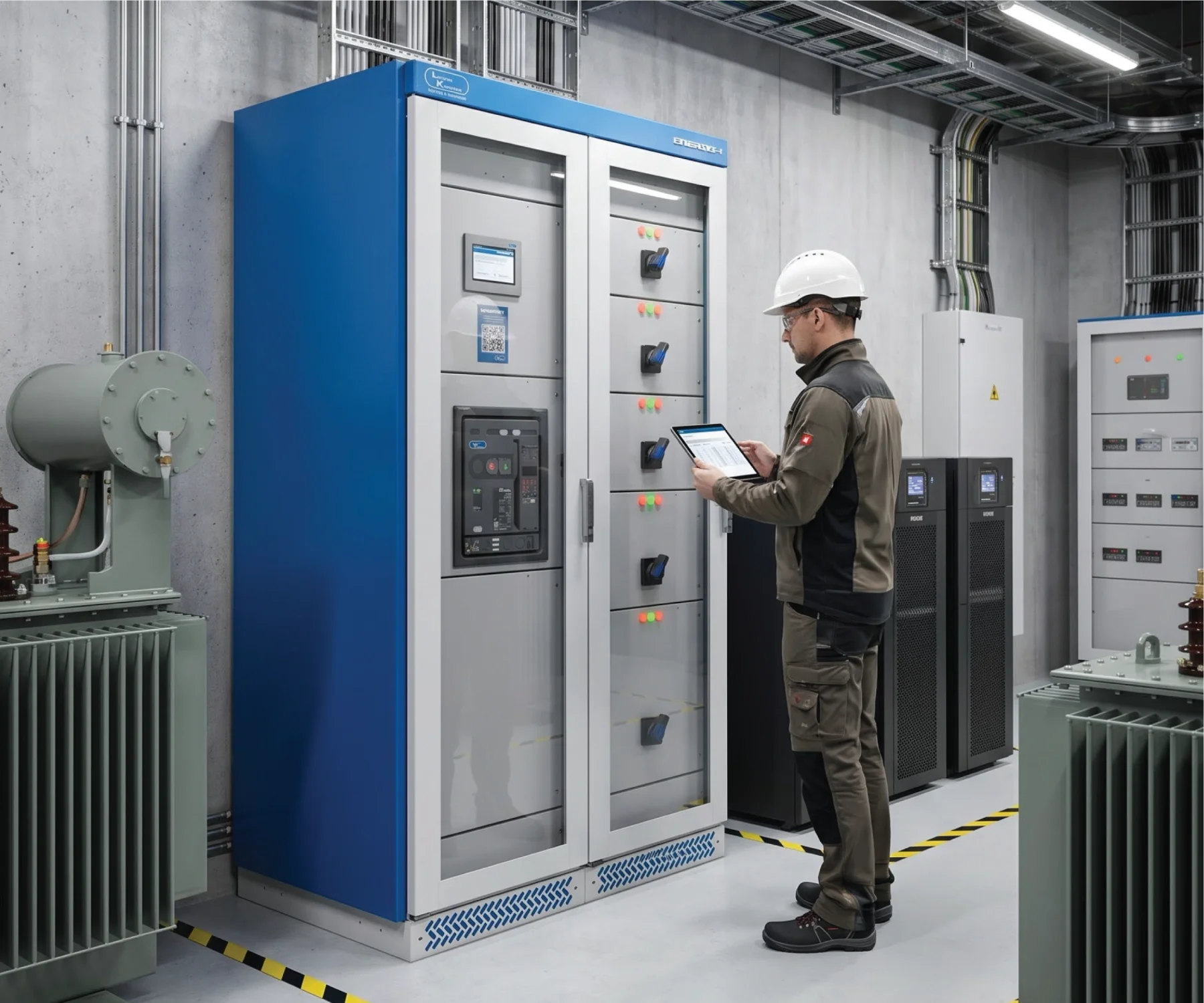
Open up a low-voltage switchgear panel, and there are circuit breakers, busbars, contactors, relays, meters, plus whatever control equipment ties the rest together. None of that is decorative. It's what routes power, catches faults before they spread, and lets someone work on the system without shutting off half the building.
A real installation has dozens of feeders running at once- motors, transformers, lighting, distribution boards, all of it live simultaneously. Simple switches don't cut it at that scale. The low voltage switchgear panel function boils down to four things: protect the equipment, isolate whatever's faulted, keep power flowing where it's needed, and hold the system together when something goes wrong.
Power comes in through one feeder, then gets split. Busbars inside the assembly carry the main current, and breakers guard each individual feeder off that. Simple as that sounds, it does two things at once- keeps circuits from stepping on each other, and leaves room to bolt on new feeders later without redoing the whole panel.
Faults are going to happen. That's not really up for debate. What can be controlled is what happens next. Breakers watch the current nonstop and cut power the second something overloads or shorts. Relays pick up the slack elsewhere- earth-fault, under-voltage, over-current, whatever the application calls for. Get the discrimination right, and only the breaker nearest the fault trips, not the whole floor.
Nobody should be touching live equipment. Isolation gear gives a visible, physical break in the circuit so nothing gets energised while someone's hands are inside it. Pulling a broken breaker without confirming isolation first is usually how people get hurt. Lockout-tagout on top of proper isolation cuts that risk down considerably, for both routine work and the bigger planned shutdowns.
Motors, pumps, compressors, fans- industrial sites switch these on and off all day long. Contactors and starters handle that switching, manual or automated. A lot of panels now hook into PLC, SCADA or building management systems, too, so operators get remote control and fault alerts without walking the floor.
Bigger breakers aren't the fix. Coordination is. Every protective device needs to trip within settings calculated for exactly where it sits in the network. This is what keeps a fault from taking out more than it should. For any operation where downtime costs real money, that coordination is the difference between a five-minute fix and a half-day shutdown.
Every piece inside an LV assembly earns its spot. Together they switch, protect, control and monitor- all at once, ideally without getting in each other's way. Picking the right low-voltage switchgear products means matching load, fault current, and the actual demands of the site, not just going by catalogue specs.
Air Circuit Breakers are normally installed as incomers or bus couplers in higher-capacity low-voltage systems. They provide high interrupting capacity, adjustable protection settings, and communication capabilities. Modern electronic trip units offer long-time, short-time, instantaneous, and earth-fault protection, enabling accurate coordination with downstream protective devices while maintaining continuity of supply wherever possible.
MCCBs protect feeders supplying large distribution boards, machinery, HVAC equipment, and industrial loads. Compared with miniature circuit breakers, they accommodate higher current ratings and greater breaking capacities. Adjustable thermal and magnetic trip settings allow engineers to coordinate protection according to cable ratings, load characteristics, and calculated fault levels within the electrical installation.
MCBs are primarily used for final distribution circuits supplying lighting, socket outlets, and small electrical equipment. They automatically disconnect circuits during overload or short-circuit conditions. This allows safe manual switching. The selection of the appropriate tripping characteristic, such as B, C, or D curve, depends on the connected load and expected inrush current.
Unlike circuit breakers, contactors are intended for frequent switching under normal operating conditions rather than interrupting fault currents. Combined with overload relays, they form motor starters capable of controlling induction motors safely. Direct-on-line and star-delta starters rely heavily on contactors for motor control. Soft starters and Variable Frequency Drives (VFDs) may also use contactors for isolation, bypass, or control functions, depending on the motor-control philosophy and application requirements.
Protective relays continuously analyse electrical parameters including current, voltage, frequency, and earth-fault current. Modern numerical relays may also provide protection against phase imbalance, phase reversal, thermal overload, differential faults, and communication-based protection schemes, depending on the application.
Busbars are the main current-carrying conductors. They are manufactured from copper or aluminium. Busbars are designed to withstand both continuous operating currents and the thermal and electrodynamic forces produced during short circuits. Busbar systems are also verified for temperature rise and short-circuit withstand capability in accordance with applicable product standards, such as IEC 61439 for low-voltage assemblies. Appropriate sizing, insulation clearances, and support arrangements are essential to ensure reliable long-term performance.
Transient overvoltages caused by lightning or switching operations can damage sensitive electronic equipment. Surge Protection Devices divert these high-energy impulses safely to earth before they reach downstream equipment. Depending on the installation, Type 1, Type 2, or coordinated combinations of SPDs are selected to provide suitable protection against transient events. SPD selection should also consider the lightning protection zone (LPZ), the earthing system, and the surge withstand capability of the connected equipment.
Digital meters provide continuous measurement of voltage, current, frequency, active power, reactive power, apparent power, energy consumption, and power factor. Many instruments communicate using industrial protocols such as Modbus, allowing integration with energy management software and supervisory control systems for real-time performance analysis.
The enclosure protects internal equipment against accidental contact and environmental influences such as dust, moisture, and mechanical impact. Selection depends on installation conditions and required ingress protection. Proper ventilation, internal segregation, and adequate space for cable termination also contribute to safe operation and easier maintenance throughout the equipment's service life.
Different installations require different configurations depending on load characteristics, fault levels, maintenance philosophy, and operational requirements. The types of low voltage switchgear selected during system design influence protection coordination, accessibility, future expansion, and overall reliability of the electrical distribution network.
The main switchgear receives electrical power directly from the transformer or utility supply. It generally contains incoming Air Circuit Breakers, busbars, metering equipment, protection devices, and bus couplers that distribute power to downstream distribution boards while providing the primary protection for the entire installation.
Distribution switchgear divides electrical power among multiple outgoing feeders supplying lighting systems, mechanical services, production equipment, and sub-distribution boards. MCCBs and MCBs provide circuit protection, while metering devices assist in monitoring energy consumption and identifying abnormal operating conditions across different sections of the facility.
Motor Control Centres centralise motor feeders within a single assembly. Each compartment typically contains an incoming protective device, contactor, overload relay, control transformer, and associated control equipment. This arrangement improves maintenance efficiency. It also simplifies fault diagnosis and allows individual motors to be isolated without affecting neighbouring circuits.
Modern manufacturers offer fixed, withdrawable, and modular constructions. Fixed assemblies provide economical solutions where frequent maintenance is unnecessary. Withdrawable units enable faster replacement of functional modules while reducing downtime. Modular systems support future expansion, making them suitable for facilities expecting increased electrical demand during their operational lifetime.
Also Read: How PCC, MCC, MV, and LV Switchgear Work Together in Power Distribution
None of this works as isolated parts; it's the coordination that makes a distribution system dependable, not any single breaker or relay doing its job well in isolation. Every piece of LV switchgear feeds into the same outcome: safe switching, real fault protection, steady power distribution, working control, and maintenance that doesn't turn into a crisis. Get the equipment selection right, coordinate the protection properly, follow the standards- reliability follows from that, not from any shortcut around it.
Manufacturers such as Lauritz Knudsen Electrical & Automation carry a broad range of low voltage switchgear products- Air Circuit Breakers, Moulded Case Circuit Breakers, Miniature Circuit Breakers, Contactors, Distribution Boards, Protective Relays, and related distribution solutions for commercial, industrial and infrastructure sites.

 Contact Us